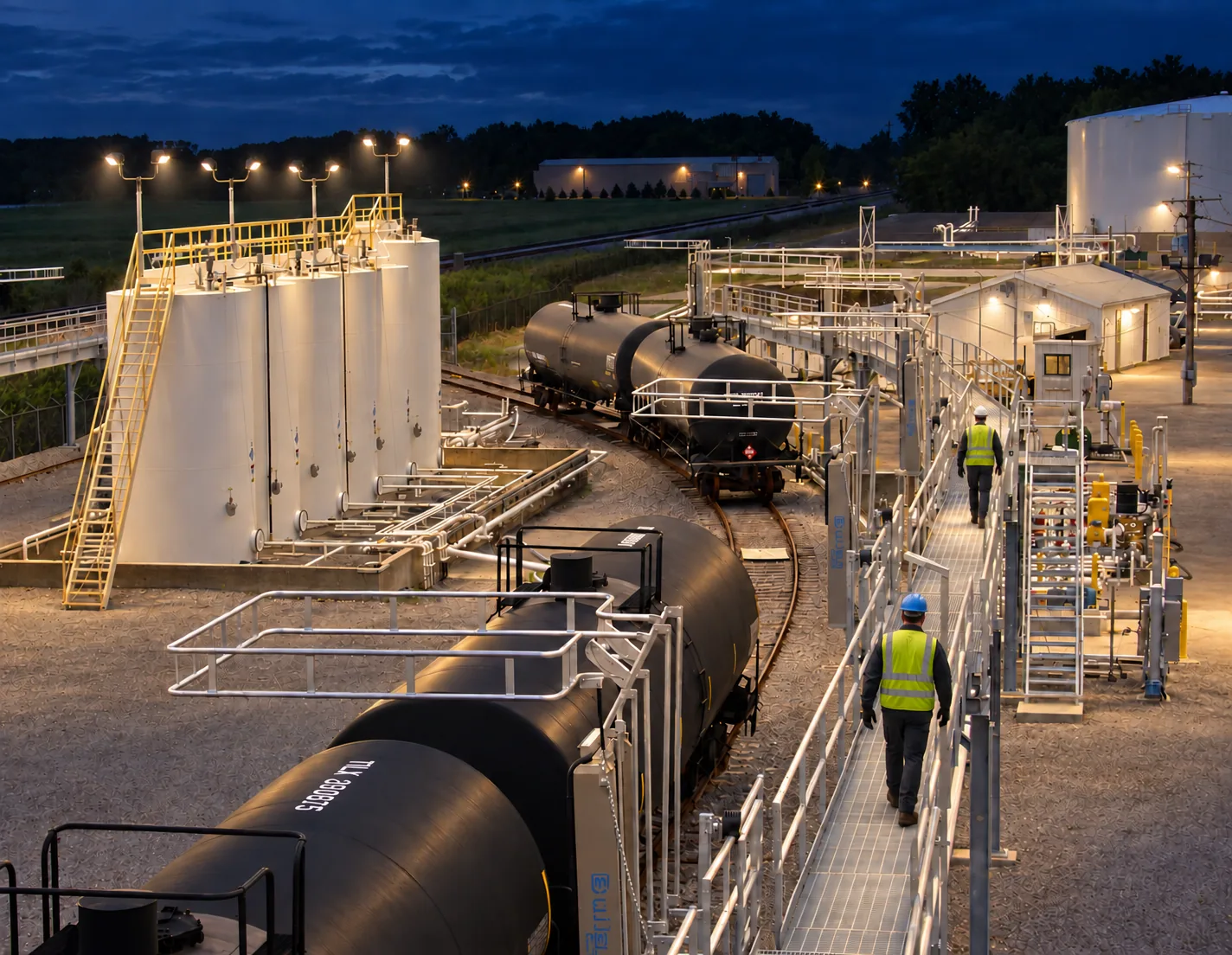
A railcar loading platform is best planned as a working system: the track and spotting pattern establish the geometry, while the task, transfer point, vehicle range, and site constraints establish what the platform must support.
System variables
- Spotting pattern
- Document the number of service positions, rail centerline, track condition, spotting tolerance, and whether railcars remain in a repeatable location.
- Working envelope
- Compare the expected railcar profiles, access heights, hatch or connection locations, obstructions, and the reach required at each position.
- Operating task
- Define whether the work is loading, unloading, inspection, sampling, maintenance, or a combination, including tools and materials workers carry.
- Site basis
- Record available footprint, access and egress, foundation information, drainage, utilities, exposure, and future expansion expectations.
Best-fit contexts
- Recurring railcar work at one or more defined service positions where a fixed access route can organize the operation.
- Projects that must coordinate access steel, transfer equipment, fall-protection interfaces, piping, containment, and site circulation.
Interfaces to coordinate
- Gangways, loading ramps, cages or enclosures, guardrail, stairs, and any owner-defined fall-protection strategy.
- Loading arms, hoses, piping, valves, instruments, utilities, and connection points at the railcar.
- Track clearance, switching practice, foundations, drainage, containment, lighting, and maintenance access.
Limits and review points
- A representative railcar profile cannot establish fit for every vehicle expected at the site; the operating range must be documented.
- Rail curvature, grade, clearance, soil or foundation conditions, and existing structures can materially change the system concept.
- Final structural, process, electrical, environmental, and worker-safety criteria remain with the responsible project professionals and site owner.
Project-brief checklist
- Rail plan or marked-up aerial with centerlines, service positions, and switching direction.
- Railcar types, dimensional profiles, access points, and expected spotting tolerance.
- Task sequence, crew size, tools, connection method, and desired throughput pattern.
- Photos and dimensions of track, grade, nearby structures, utilities, drainage, and available footprint.
- Owner design basis, responsible engineering contacts, schedule constraints, and known future phases.